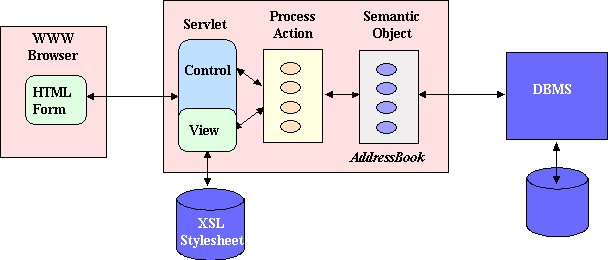
To work within this architecture, you need to recognize
several basic requirements and/or tasks:
-
All interaction with the user is through html pages,
especially html forms.
-
The data for forms and other html are generated by backend
objects (the model) that communicate through the servlet.
-
That data is embedded in xml.
-
The servlet is responsible for transforming the xml
generated by backend objects into html and returning the html to the user.
-
The servlet uses a separate xsl stylesheet that is merged
with the xml to produce the actual html, thereby providing a view.
-
The user enters data into forms returned by the system and
presses buttons signifying the desired action (e.g., add, search, update,
delete).
-
The servlet provides control services,
figuring out what action the user desires to be done and sending the
appropriate information to an appropriate object to begin carrying out the
action.
-
To keep programming as simple as possible, several layers
of processing may be used to accomplish an action.
-
This architecture is well-suited for using DataBeans,
especially for user interface data, for entry data, and for view
data. The last is a good place to generate most of the actual xml.